Specialist Treatment · Kentford & Newmarket
Disc Bulge Treatment Without Surgery
A disc bulge isn't a life sentence. With the right diagnosis and IDD Therapy, most patients we see recover without injections or surgery.
Someone showed you the MRI. They circled it. They used the word 'bulge' or 'herniation' or 'protrusion' and your stomach dropped. Now you're scared to bend, scared to lift, scared to sneeze. The leg pain or back pain is real, but the fear is making it worse. You've been quoted for an injection, mentioned to a surgeon, told to 'just see how it goes'. You want a third option.
Why Most Treatment Fails
Disc bulges fail conventional treatment for one core reason: most modalities cannot reduce the intradiscal pressure that's causing the bulge to press on a nerve. Painkillers numb the symptom, anti-inflammatories quiet the inflammation around the nerve, but neither does anything to the disc itself. Massage and generic mobilisation feel pleasant, change nothing structurally. The bulge stays. The pain returns.
Generic core exercises are routinely the wrong answer for an acute disc bulge. Loading a compromised disc with planks, deadlifts, sit-ups, or spinning classes typically aggravates the problem. We see this constantly: patients who've been doing 'rehab' for months and getting steadily worse, because nobody assessed which direction the disc was responding to before prescribing the exercises. The exercise sheet was generic. The disc isn't.
Injections and surgery have a place — but they're often offered too early. Epidural injections give temporary symptom relief in some cases, but don't reduce the bulge. Microdiscectomy and laminectomy can be life-changing for the right patient, but the published recovery rates in the medical literature for non-surgical disc bulge treatment are strong, and most patients aren't told that. There is a non-surgical route, and for most disc bulges, it should be tried first.
How We Diagnose It Differently
Diagnosing a disc bulge clinically is straightforward when you know what to look for. The history, the directional preference test, and the neurological examination triangulate the affected level cleanly.
Mechanical history and directional testing
How the pain behaves with flexion vs extension, sitting vs standing, walking vs lying. Disc bulges follow predictable patterns. The story tells us the level and the direction of the protrusion.
Neurological examination
Reflexes, dermatomes, myotomes, and dural tension testing identify which nerve root the bulge is irritating — L4, L5, or S1 are the common ones. This is critical for treatment targeting.
Honest review of imaging
If you've had an MRI, we'll go through it with you. We'll tell you what's clinically driving your pain and what's incidental. Many patients have multi-level changes on imaging — only one level is usually the problem.
Suitability assessment for IDD Therapy
Not every disc bulge is right for IDD Therapy. We screen for contraindications — instability, certain post-surgical situations, severe osteoporosis. If you're not a candidate, we'll tell you and refer appropriately.
How We Treat It
When the diagnosis is a contained or moderately extruded disc bulge, treatment is mechanical, specific, and progressive.
IDD Therapy spinal decompression
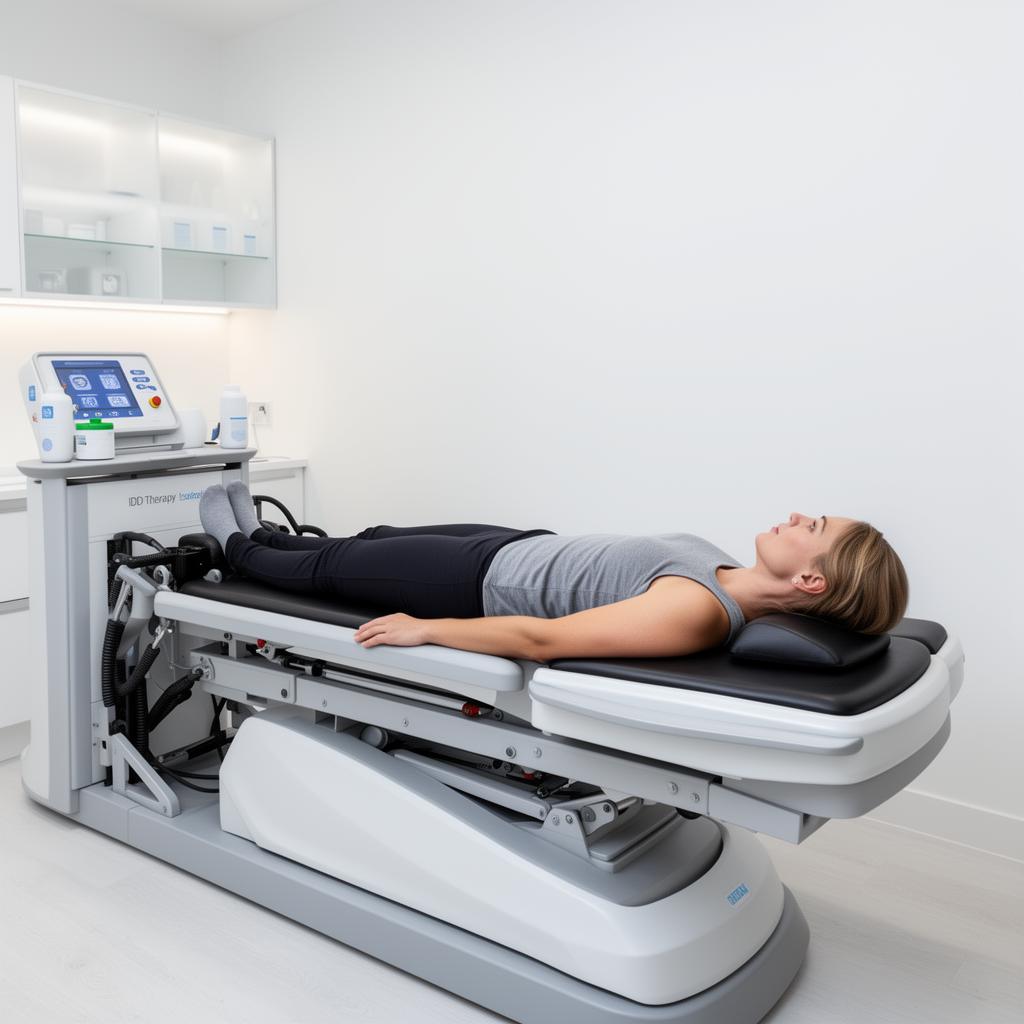
The flagship treatment. Computer-controlled distraction at the precise affected segment reduces intradiscal pressure, creates negative pressure inside the disc, and gives the bulge the conditions to retract. A typical course is 8–12 sessions, and meaningful symptom change is usually evident by session 4–6.
Targeted manual therapy
Releasing the protective muscle spasm pattern, mobilising adjacent segments to reduce load on the affected level, and neural mobilisation to free a tethered nerve root. Hands-on work that complements the IDD treatment.
Direction-specific rehabilitation
McKenzie-based exercises matched to your directional preference. Deep stabiliser retraining once acute symptoms ease. Graded reintroduction of loaded movement once the disc has settled. The wrong exercises set patients back; the right ones consolidate recovery.
Activity, posture, and load coaching
Sitting, driving, sleeping, lifting, bending — the daily mechanics that either keep the disc loaded or let it heal. We teach you the small things that make a big difference over weeks and months.
Honest timelines: A typical IDD Therapy course for a disc bulge is 8–12 sessions over 6–10 weeks. Most patients feel meaningful change by session 4–6. Symptoms often continue to settle for 2–3 months after the course ends as the disc consolidates. Larger extrusions or sequestrations may need longer or, in a small number of cases, surgical referral.
Representative case
What Recovery Looks Like in Practice
- Patient
- Male, early 60s, recently retired, keen golfer and gardener. Active man who'd been told to 'consider an operation'.
- Presentation
- 12 weeks of escalating right-leg pain following a gardening incident. Severe pain on sitting, unable to sleep flat, walking limited to 200 metres. MRI showed a large right paracentral L5/S1 disc extrusion impinging the S1 nerve root. Surgical opinion offered microdiscectomy.
- Diagnosis
- Right S1 nerve root compression secondary to L5/S1 disc extrusion, with extension directional preference. Clinically suitable for non-surgical management as a first-line trial, with surgical option held in reserve.
- Treatment
- 10 IDD Therapy sessions across 7 weeks. Extension-bias rehabilitation progressed weekly. Manual therapy and neural glides. Sleeping position, sitting tolerance, and walking dose managed weekly.
- Outcome
- Leg pain reduced from 8/10 to 1/10 by session 8. Walking tolerance returned to 5km by week 10. Back to golf at 14 weeks. Surgery cancelled. Maintenance home programme. Stable at 12-month review.
Composite case based on the typical patient profile we treat. Individual outcomes vary.
Transparent Pricing
Initial Assessment
£70
Full history, examination & treatment plan
Treatment Session
£55
Hands-on treatment & rehab
Typical Course
4–8
Sessions for most patients
Frequently Asked Questions
Can a disc bulge actually heal?
Yes — and the medical literature now supports this clearly. Disc bulges and even larger extrusions can reduce in size over time, particularly with the right load management. IDD Therapy creates the mechanical conditions to support that process. We see substantial symptom resolution in the majority of cases.
How is IDD Therapy different from traction?
Traditional traction is a continuous pull on the whole spine, which the body resists by tightening up. IDD Therapy is computer-controlled, segment-specific, oscillating distraction at the precise affected level. The difference in clinical effect is significant — IDD targets the disc; traction doesn't.
Will I need surgery in the end?
In our experience, the majority of patients who complete a full IDD Therapy course for a disc bulge avoid surgery entirely. Surgery remains the right answer for a small number — those with progressive neurological deficits or severe sequestrations. We'll tell you honestly if you're in that group.
Is IDD Therapy painful?
No. Most patients describe it as a strong but comfortable stretch in the lower back. Many fall asleep during sessions. There's no manipulation, no cracking, no impact.
Can I exercise during the IDD course?
Yes — but only the exercises we prescribe. Gym work, running, lifting, and high-load training are usually paused during the active phase of treatment. Walking and our prescribed home exercises are encouraged. Reintroduction is staged over the final weeks.
What if I've already had a discectomy?
We assess post-surgical patients individually. Many do well with IDD Therapy for adjacent-level problems or recurrent disc issues, provided there's no metalwork at the level we'd treat. Some are not suitable. The first assessment will tell us.
Related Conditions We Treat
Get the Diagnosis That Actually Explains Your Pain
Stop guessing. Book a proper assessment with Lee and the BodyCare team.